By EC Team · Updated October 2, 2026 · 7 min read
In Part 4 of our Amazon Product Research Guide, we looked at how I use Hot New Releases and FBM to identify and test early-stage product opportunities.
This time, we’ll look at a similar product research approach from an FBA perspective.
Rather than focusing on FBA fees, logistics, or inventory management, I want to focus on one specific question:
What kind of FBA product might be easier for a new seller to start with?
The product I found is a small cocktail umbrella set.
I haven’t personally sold this product. I’m using it as an example because it combines several characteristics I tend to look for when evaluating products for a new seller: relatively short listing history, real sales, stable pricing, a manageable review barrier, a simple product structure, and room for meaningful differentiation.
Importantly, I’m not saying that FBA products need to be small, light, or inexpensive.
There are plenty of successful FBA businesses built around large, expensive, or complex products.
The point here is simply that for a new seller, a relatively simple product with a more manageable initial cost can reduce the difficulty and risk of getting started.
1. Start With a New Product Opportunity
The first thing I noticed was that this product appeared in a relevant New Releases category and had a relatively short listing history.
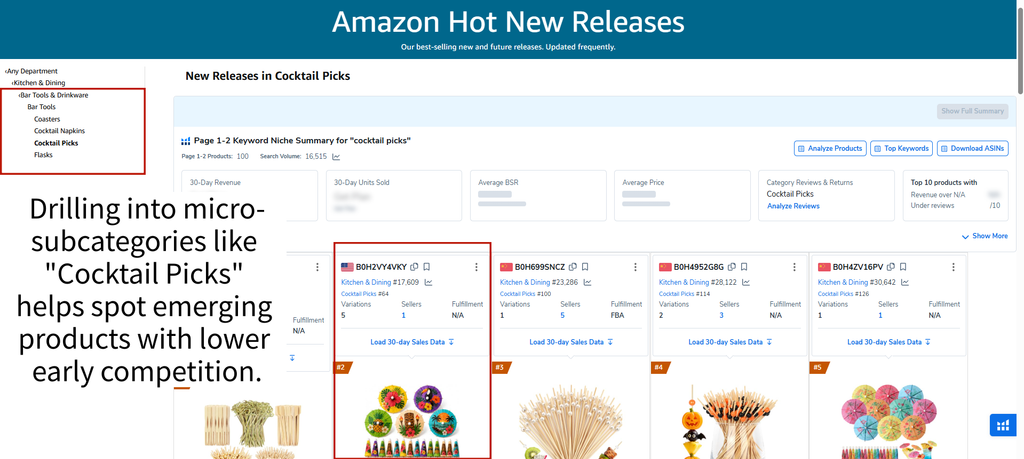
This is important because I generally don’t want to enter a product that has already been established for years with a large number of strong competitors.
A newer product gives us more room to investigate:
- How quickly is it gaining sales?
- How many competitors have already entered?
- How many reviews has it accumulated?
- Is the current price stable?
- Is there still room to improve the product?
Finding a new listing doesn’t mean it will succeed.
It simply gives us an opportunity to study the product before the market becomes more established.
2. Look for Real Demand and Stable Pricing
A new product by itself isn’t enough. The next question is whether people are actually buying it.
Using Helium 10, I look at the product’s estimated sales history and price history.
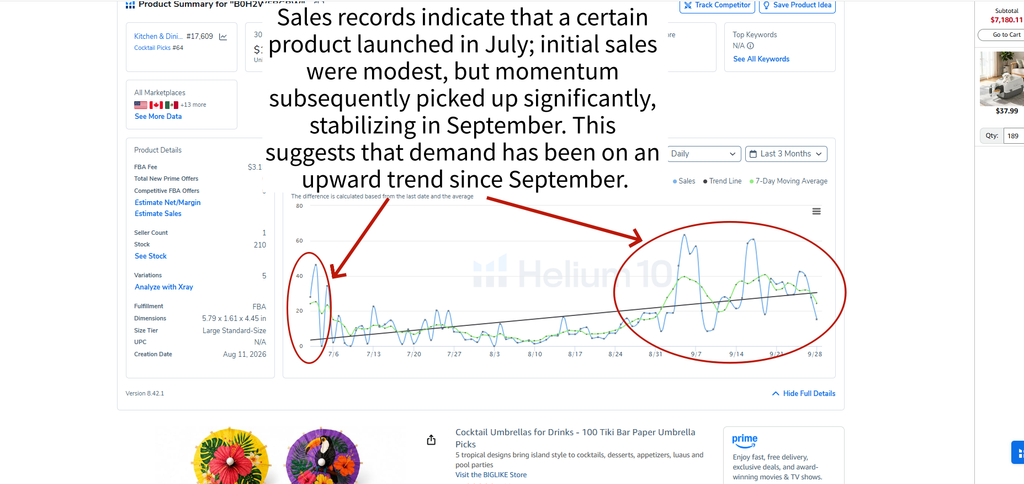
In this example, although the product had been listed since August (with early sales data going back to July), its initial performance was fairly quiet. The sales level didn’t truly take off until late August and September, where it stabilized at a much healthier daily volume.
More importantly, this growth looks like sustained momentum rather than a single short-lived spike.
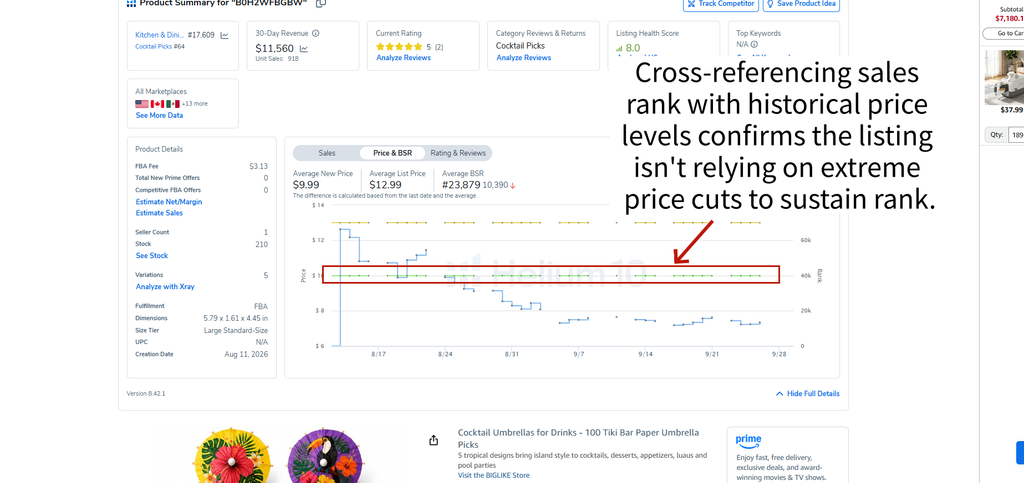
The price was also relatively stable during this sales takeoff rather than constantly falling[cite: 5]. This matters because a product can rank highly for a short period because of steep promotions, deep discounts, or other temporary factors.
I want to see a combination of:
new product + real, stabilizing sales activity + relatively stable pricing.
That combination is much more interesting than simply finding something new.
3. Look at the Review Barrier
Reviews are another important part of the evaluation.
I’m not necessarily looking for a product with exactly zero reviews.
A small number of reviews can actually be useful because they give us something to analyze.
If there are only a few reviews, I want to understand:
- What do customers like?
- What do they dislike?
- Are there repeated complaints?
- Is there something about the product that could realistically be improved?
For example, if several customers complain about the same design problem, packaging issue, or usability problem, that may provide a direction for product improvement.
The goal isn’t simply to find a product with bad reviews.
The goal is to find a product where the existing competition has not yet built a very strong review barrier, while there is still room to make the product better.
4. Why Simple Products Can Be Easier for New Sellers
This is where the cocktail umbrella example becomes more interesting.
The product is relatively small, light, and simple. It doesn’t have a complicated structure, sophisticated electronics, or many technical components.
For a new seller, these characteristics can be useful because they can make the initial investment and testing process easier to manage.
A product like this may offer several practical advantages:
- Lower Initial Cost: A relatively simple, low-cost product can be easier to start with when your initial budget is limited.
- Lower Testing Risk: If the product doesn’t perform as expected, a smaller initial investment can make the loss easier to absorb.
- Easier Product Management: With fewer technical or structural details, there are fewer things to understand and manage.
- Easier Customization: Simple products can often be modified through design, packaging, materials, or themes without completely redesigning the product.
For a new seller, I generally like products where the cost of making a mistake is easier to control.
That’s one reason this type of product caught my attention. simple and lower-cost product can be a more manageable place to start.
5. Look for Differentiation Customers Can Actually See
A simple product still needs a reason for customers to choose it.
A product being customizable doesn’t automatically mean it is differentiated. The difference needs to be meaningful from the customer’s perspective.
Cocktail umbrellas are a good example.
Instead of selling a completely generic umbrella, a seller could develop a more specific visual theme, such as Tiki, Hawaiian, tropical, or island-style designs.
The underlying product is still simple, but the theme can change the way customers perceive and use it.
This is the type of differentiation I look for.
Not:
“Can I technically change this product?”
But:
“Will the customer actually notice and care about the difference?”
If the answer is yes, the product has more room for differentiation.
Before moving forward, I would also do a basic check for trademark, patent, and copyright issues. I covered the detailed process in [Amazon Product Research Guide (Part 2): Found a Product You Want to Sell? Do This First.] [INSERT INTERNAL LINK]
Final Thoughts
This is only one way to approach Amazon product research.
There are many different ways to find product opportunities, and different sellers may use completely different criteria.
I don’t think every new seller needs to look for small, light, or simple products. Large products, high-priced products, and more complex products can also be viable businesses.
But when you’re just starting out, it can make sense to consider products where the initial investment, product complexity, competition, and differentiation are relatively manageable.
The goal isn’t to find a “perfect” product.
It’s to find an opportunity where there are fewer obstacles to overcome and still enough room to improve or differentiate the product.
This is simply one product research approach. The more products you analyze, the more you’ll develop your own criteria for deciding which opportunities are worth pursuing.