By EC Team · Updated September 28, 2026 · 7 min read
In Part 1 of our Amazon Product Research Guide, we looked at how Amazon’s Best Sellers and Hot New Releases pages can help you find product ideas.
This time, we’re taking the New Releases method one step further. Instead of simply looking for new products, we’ll focus on identifying products that are starting to gain traction before competition becomes too established.
Once you find a promising product, FBM can also give you a practical way to test real customer demand without first committing inventory to Amazon’s fulfillment network.
Here is the step-by-step workflow I use to find, evaluate, and quickly test early-stage product opportunities using Amazon’s storefront and the Helium 10 Chrome extension.
Step 1: Drill Down into Micro-Niches (Avoid General Traffic)
When browsing Amazon’s Hot New Releases page, avoid broad, high-level categories like Pet Supplies or Home & Kitchen.
The Strategy: Always drill down into 3rd or 4th-level subcategories (e.g., Pet Supplies > Cats > Carriers & Strollers > Carriers > Hard-Sided Carriers).
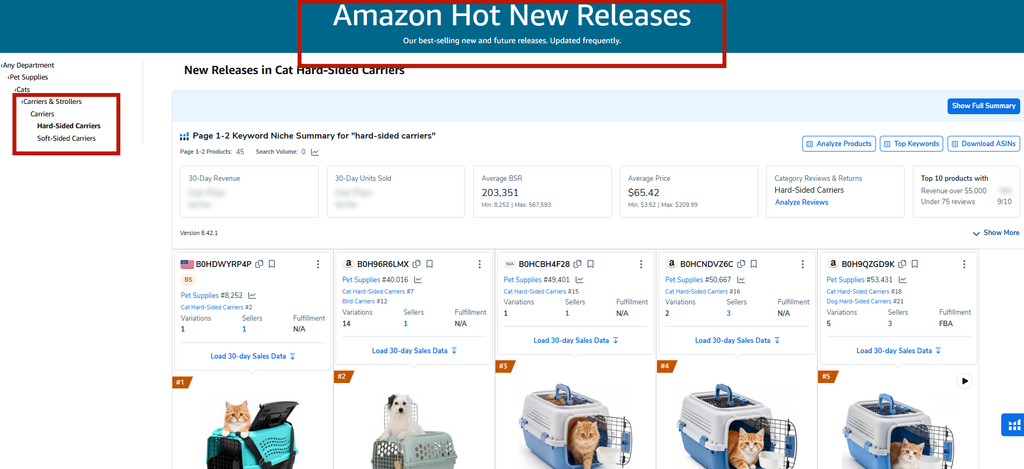
- Why This Matters: High-budget campaigns and entrenched sellers dominate broad categories. In contrast, micro-niches offer highly targeted buyer intent. Narrow subcategories ensure your initial ad dollars reach ready-to-buy customers without getting swallowed by high-volume search terms.
Step 2: Validate Demand First (Check Rank & Estimated Sales)
Run a quick sales validation on the Hot New Releases chart before opening product detail pages.
The Strategy: Focus exclusively on listings positioned near the top of the chart that show healthy sales velocity.
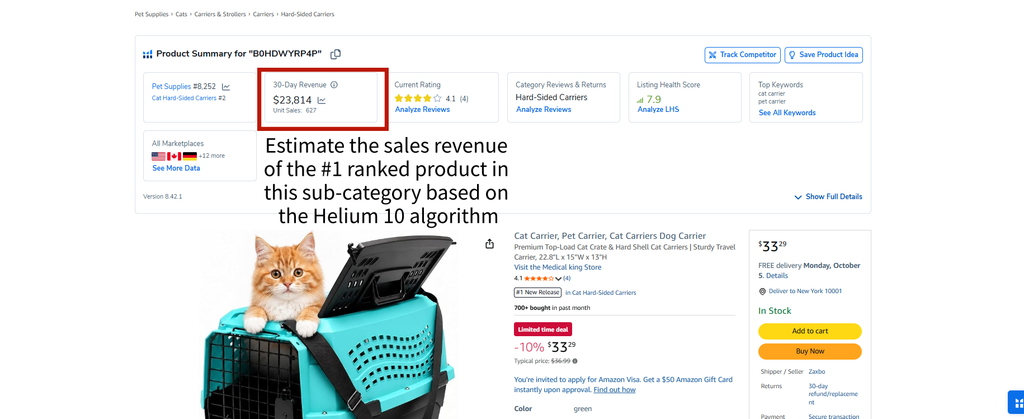
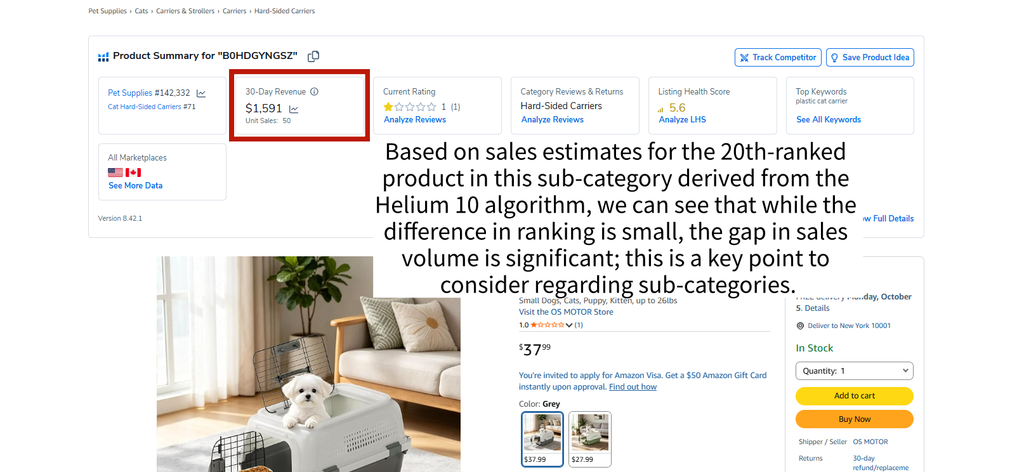
- Why This Matters: In micro-niches, rankings alone do not directly tell you how many units a product is selling. A product can rank well in a small subcategory while still generating relatively little sales volume. Use the ranking as an initial signal, then look at estimated sales to determine whether the product is showing meaningful demand.
- Real Example: Consider a hard-sided plastic cat carrier ranked #1 in Cat Hard-Sided Carriers (and #8,252 in Pet Supplies). Using the Helium 10 extension overlay, we can see an estimated 627 monthly unit sales at a $33.29 price point. This gives us a stronger indication that the product is getting real customer demand before we spend more time researching it.
Step 3: Leverage FBM for Speed-to-Market Testing
When analyzing an early-stage product, also pay attention to how the seller is fulfilling orders.
The Strategy: If a promising product is being sold through FBM (Fulfilled by Merchant), this can be an interesting signal to study. FBM allows a seller to start selling without first sending inventory into Amazon’s fulfillment network.
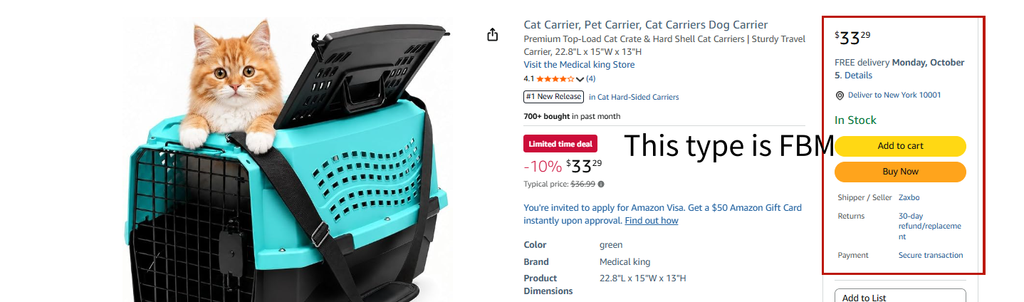
- Why This Matters:
- Faster Market Testing: You can start testing demand without waiting for inventory to be received into Amazon’s fulfillment network.
- Lower FBA Inventory Commitment: If the product does not perform as expected, you have not already committed a large quantity of inventory to FBA.
- Flexible Transition: If the product shows consistent demand, you can later consider moving more inventory into FBA.
For a new product, this can be a practical way to test the market before making a larger inventory commitment.
Step 4: Filter for Low Reviews & Analyze Negative Feedback
One of the main goals of this strategy is to find products before they build a strong review moat.
The Strategy: Start by looking for products with no reviews or very few reviews. If a product already has a meaningful number of reviews, pay closer attention to its negative feedback and look for repeated problems.
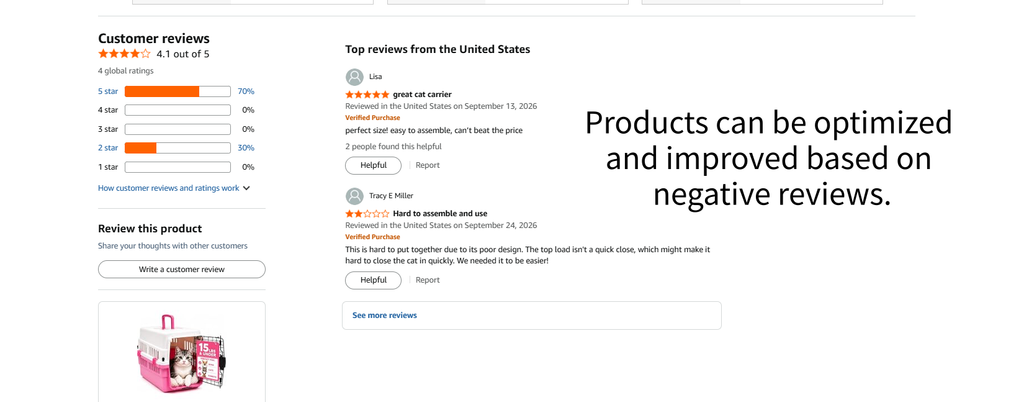
- No or Very Few Reviews: A product with strong sales signals but little or no review history can be worth investigating. It may indicate that the listing is still in its early stage and has not yet built a significant review advantage.
- Products With Existing Reviews: Don’t automatically reject a product just because it has reviews. Instead, read the 1-star, 2-star, and 3-star reviews and look for repeated, fixable complaints. For example, several customers may mention that a latch breaks easily, a door is difficult to open, or a component feels too weak.
In our cat carrier example, the product reached the #1 Hot New Release position with only 4 reviews and a 4.1-star rating. The combination of strong ranking and a very small review base makes it an interesting product to investigate further.
The key is not simply finding products with low ratings. Look for products with either a low review barrier or clear problems that you can realistically improve.
Step 5: Identify When the Product First Started Selling
A product’s listing creation date does not necessarily tell you when it actually started selling.
The Strategy: Use Helium 10’s historical sales data to check when a newly launched product first began showing sales activity.
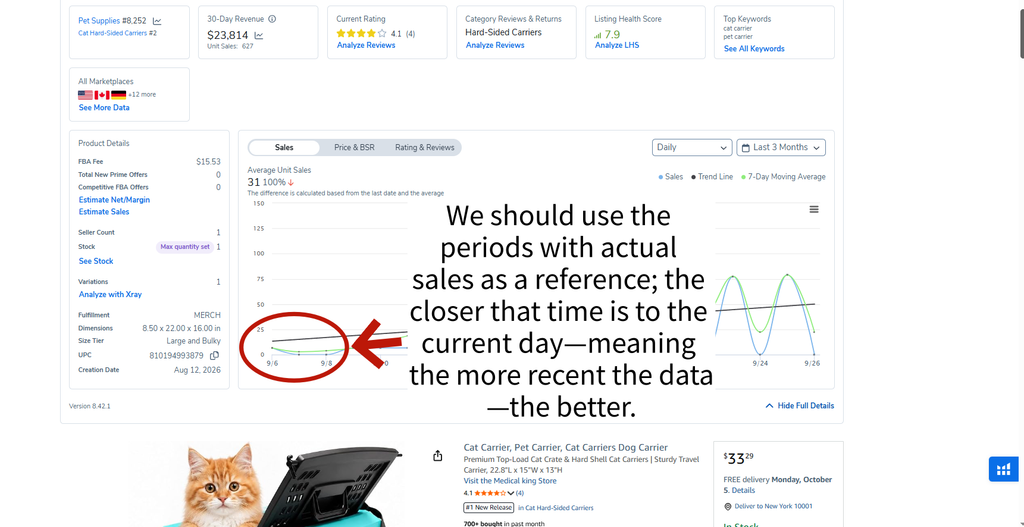
- Real Example: The ASIN B0HDWYRP4P was created on August 12. However, when we look at its historical sales data in Helium 10, sales activity begins to appear around September 6.
- Why This Matters: This gives us a much better idea of when the product actually entered the market and started generating sales. Instead of only looking at the listing creation date, we can use historical sales data to identify when the product appears to have received its first sales and started gaining traction.
- This is especially useful when researching products found through Hot New Releases. If a product was listed weeks ago but only started showing sales recently, it may represent a much earlier stage of the product’s market development than the listing creation date suggests.
- The goal is to find products that are still relatively early in their sales cycle, rather than products that have already been selling successfully for months.
Critical Red Flags: Two “Fake Demand” Traps to Avoid
A sudden spike in sales rank doesn’t always equal genuine organic demand. Screen for these two common traps before shortlisting an item:
1. The Hijacked Listing Trap (Multiple Sellers & Price Wars)
Check the Buy Box and Helium 10 panel to see how many sellers are operating under a single listing.
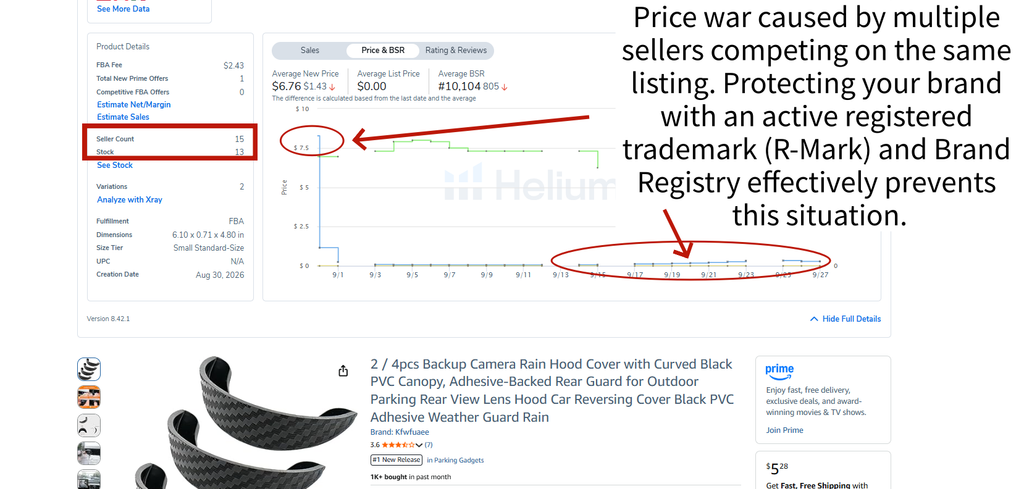
- The Risk: In the example above, the listing shows a Seller Count of 15. Multiple sellers jumping on the same ASIN force a continuous race to the bottom on price (dropping from nearly $7.50 down to $5.28). When sales volume is split among 15 hijackers, the estimated revenue per seller plummets, making it impossible to build a profitable private-label business.
- How to Avoid & Protect Yourself: Always target private-label opportunities and avoid listings dominated by reseller competition. Once you launch your own product, protect your listing from hijackers by securing an active Registered Trademark (R-Mark) and enrolling in Amazon Brand Registry.
2. The Off-Site Deep Discount Illusion (Deal Sites & Facebook Groups)
Sellers frequently boost brand-new listings onto the chart by running massive off-site promotions (e.g., 50% to 80% OFF coupons via deal sites).
- The Risk: A steep upward curve in sales rank may simply reflect deal seekers grabbing heavily discounted items. Once promotional spending stops, organic sales plummet back to zero.
- How to Avoid: Cross-reference Helium 10’s price history with the sales rank curve. If a BSR spike corresponds with a sharp drop in list price or heavy coupon badges, treat that sales volume with suspicion.
Conclusion: The Core Essence is Speed and Consistency
To master the Hot New Releases strategy, remember this core principle: It is entirely driven by speed.
The product examples shown in this guide merely demonstrate the workflow. In practice, the faster you spot an opportunity, the higher your odds of winning.
The Ideal Scenario: The best opportunity is catching a product on the very first day it shows sales data. You don’t need it to be the #1 top seller—it just needs a reasonably strong rank in its micro-niche to prove it is getting orders. Catching an item right when it starts selling puts you on the exact same starting line as the competitor, before they build keyword indexing, listing authority, or review weight.
However, these breakout opportunities don’t happen every day. Most brand-new listings stay quiet because they lack initial traffic. The few that spike onto the chart often caught a temporary wave of momentum—such as viral social media trends or off-site PR exposure.
That is why this framework requires daily consistency and long-term observation. By making it a daily habit to monitor micro-niche Hot New Releases charts, you train your product sense and position yourself to strike instantly when the right opportunity appears.