By EC Team · Updated October 5, 2026 · 5 min read
In Part 5 of our Amazon Product Research Guide, we explored a beginner-friendly FBA product research approach using a cocktail umbrella set as a case study.
Once you identify a product worth pursuing, the next step is finding suppliers and figuring out who is actually worth contacting.
For many cross-border e-commerce sellers, Alibaba is one of the easiest places to start sourcing.
1. Take a Product Image and Search on Alibaba
You don’t always need to know precise technical keywords or industry jargon to start sourcing.
If you find an interesting product on Amazon, one of the easiest approaches is to take a screenshot of the main product image and upload it directly to Alibaba’s Image Search feature.
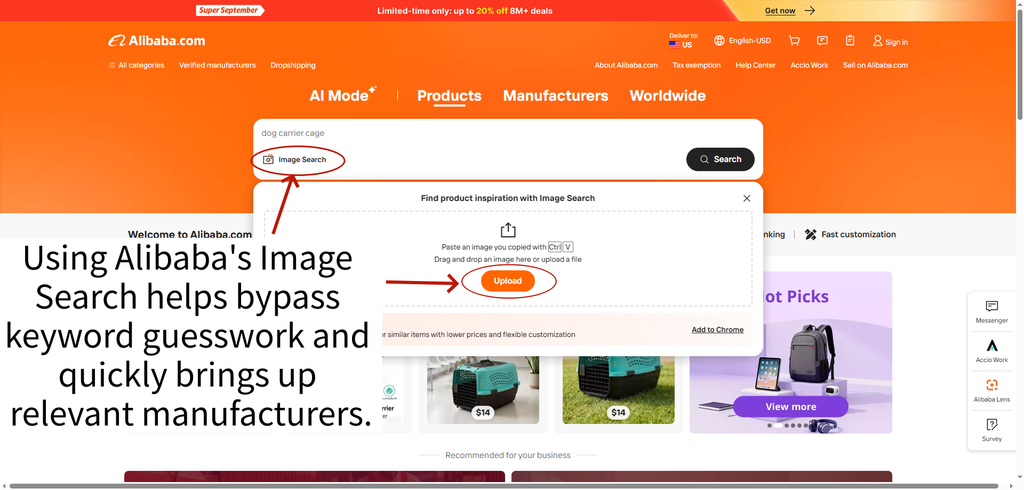
Alibaba will automatically show visually similar products.
This is especially useful for products with distinct shapes, custom prints, or multi-item bundles like our cocktail umbrella set.
At this stage, your goal isn’t necessarily to find the exact supplier used by your Amazon competitor.
You are simply establishing a baseline and finding suppliers capable of making similar products.
2. Compare Multiple Alibaba Suppliers Side-by-Side
After running an image search, review several matching listings and look into the companies behind them.
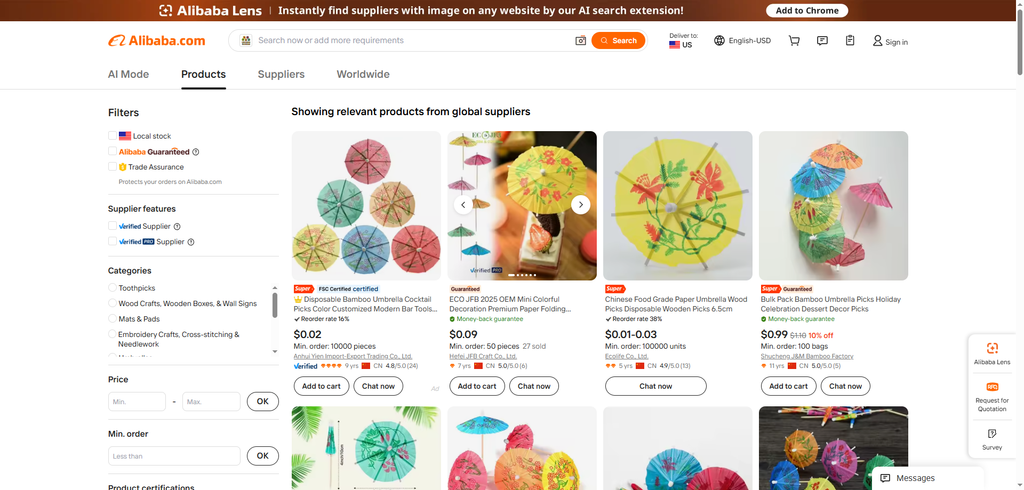
I wouldn’t reach out to just one supplier.
I would usually shortlist 5 to 10 suppliers and compare their:
- MOQ (Minimum Order Quantity)
- Tiered Unit Pricing
- Customization & Packaging Options
- Sample Costs & Delivery Lead Times
- Communication Responsiveness
Factories vs. Trading Companies
Suppliers on Alibaba can vary significantly in product quality, service, communication, and production capabilities.
Not every supplier is a direct factory. Some are trading companies or sourcing companies that work with different manufacturers.
That doesn’t automatically mean they are worse.
In some cases, a trading company may offer lower MOQs, easier communication, or access to multiple factories.
The important thing is to understand who you are actually dealing with and what they can provide.
If you aren’t comfortable with supplier verification, quality inspections, or direct negotiation, a reliable China-based sourcing agent is another option worth considering.
3. Send a Standardized Inquiry Template
Once you have a shortlist, send essentially the same requirements to each supplier.
This makes their responses much easier to compare.
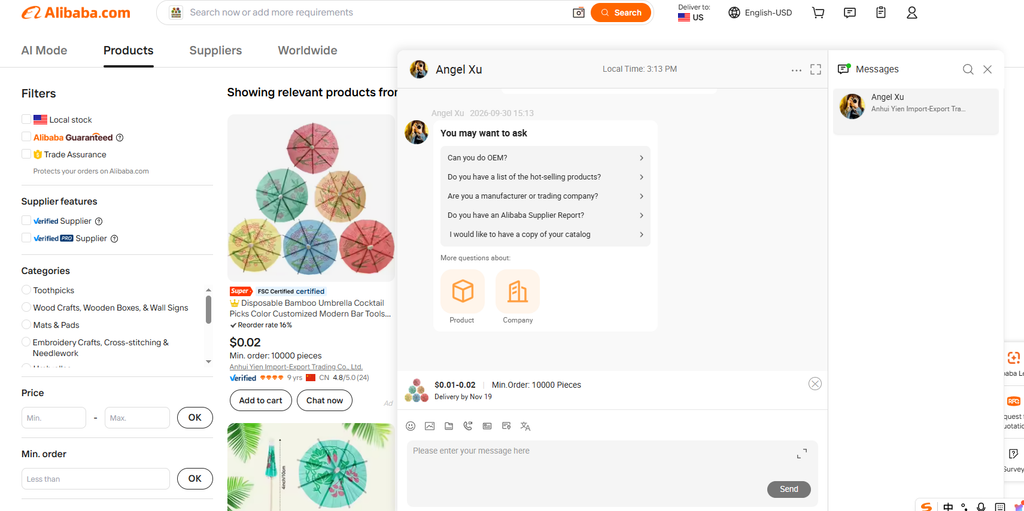
Here is a straightforward template you can use:
“Hi [Supplier Name],
I am looking to source this product for the US Amazon market.
Could you please provide details on:
- Tiered pricing for 500 and 1,000 units?
- Your standard Minimum Order Quantity (MOQ)?
- Custom packaging and branding options?
- Sample cost and shipping time to the US?
Thank you!”
Using the same requirements for each supplier allows you to compare unit prices, sample fees, MOQs, customization options, and production lead times more easily.
Don’t just look at the lowest quotation.
A slightly higher price may come with better quality, lower MOQ, better customization, or better communication.
Final Thoughts
Don’t be afraid to compare several suppliers before making your decision.
A reliable and stable supplier is important, especially when you’re building a business around a product you plan to sell for the long term.
At the same time, good suppliers also want reliable customers who can place repeat orders and build a long-term relationship.
So I wouldn’t focus only on finding the lowest price. If you find a supplier with consistent quality, good communication, reasonable pricing, and the ability to support your business as it grows, that’s often much more valuable in the long run.